


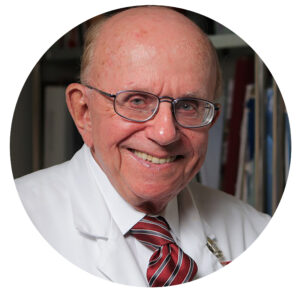
Few individuals have shaped the myeloproliferative neoplasm (MPN) field as steadily and thoughtfully as Dr. Richard T. Silver, MD, FACP, whose career exemplified the power of patience, independence, and long‑term scientific commitment. Over decades, he helped move the field forward by asking difficult questions early, standing by promising science long before it gained consensus, and contributing to standards of research, care, and collaboration that continue to shape how MPNs are understood today. His influence, as the “grandfather of the field,” did not rest on a single defining moment, but on a consistent set of values that guided how he practiced medicine and engaged with the field.
Dr. Silver often described his entry into hematology as accidental. “I became interested in the blood cancer field strictly by accident,” he recalled in his documentary, The Accidental Hematologist, reflecting on a series of circumstances that placed him at the National Institutes of Health at a time when cancer medicine was, as he put it, “the gulag of all the specialties.”
What began as a reluctant assignment gradually became a source of fascination. Surrounded by mentors asking rigorous, unresolved questions, Dr. Silver gradually found himself drawn to the complexity of the work and the seriousness of the inquiry. “I was so intrigued by the people who were presenting, who were so much smarter than I was, that I became really involved.” That openness to learning defined his approach to medicine and science.
What followed was a career that reshaped how blood cancers, particularly myeloproliferative neoplasms, are understood, diagnosed, and treated. Dr. Silver helped define diagnostic criteria for polycythemia vera and was widely credited with developing and popularizing the bone marrow biopsy technique now used worldwide to diagnose hematologic disorders. That work culminated in the 1970 publication of The Morphology of the Blood and Marrow in Clinical Practice, a landmark textbook that helped standardize how clinicians and pathologists evaluate blood and marrow disease. Together, these contributions established diagnostic frameworks that continue to underpin modern hematology.
He also championed interferon as a therapeutic approach even when its use was considered controversial. As noted in recorded conference remarks, one colleague observed, “There’s been forty years of experience of interferon in hematological malignancy in general, and a lot of that has been shaped by Dr. Silver.” For patients, that long view could be life altering. In recorded remarks honoring Dr. Silver, Dave Boule, a long‑time patient, said, “He recommended a treatment — interferon — that at the time was considered quite controversial. But Dick believed in it. And I stand here today because of that belief.” Boule later added in those same remarks, “Quite literally, Dick saved my life.”
Dr. Silver’s leadership in interferon research also extended into research stewardship and community partnership. As the MPN field sought to better understand and advance interferon‑based approaches, he served as a scientific advisor to MPN Research Foundation’s 2017 MPN Interferon Initiative, helping guide research investment with the same rigor and long‑term perspective that defined his own work. His involvement reflected not only scientific judgment, but a deep commitment to the people affected by these diseases.
In a shared message, Barbara VanHusen, co‑chair of MPN Research Foundation, said, “We had the honor of knowing and working with Dr. Silver over many years. His tireless efforts on behalf of MPN patients everywhere were matched by his wit and kindness as a colleague and a friend. He will be missed by us all.”
Dr. Silver’s influence extended well beyond his scientific contributions and was known for his attentiveness, generosity with time, and insistence on intellectual honesty. He encouraged trainees to embrace uncertainty rather than avoid it. “Life is very unpredictable, and you never know what can happen,” he advised in recorded oral history remarks. “So, give it your shot and see what happens.” That philosophy shaped not only how he taught, but how he practiced medicine day to day. He arrived prepared, stayed engaged, and treated every interaction with care and respect.
Those values also took durable form in the institutions he helped build. Dr. Silver spent decades at Weill Cornell University School of Medicine, where he established a professional home that seamlessly integrated clinical care, research, and mentorship. Speaking in recorded remarks, Dr. Morton Coleman said he first met Dr. Silver more than 50 years ago and came to know him as “a mentor, colleague, co‑researcher, and friend.” Coleman added that Dr. Silver “had an enormous impact on the field of hematology/oncology,” noting his early recognition of the importance of targeted therapies, particularly in chronic myelocytic leukemia, and his lasting contributions to Cornell medicine. Dr. Silver also founded the Cancer Research & Treatment Fund (CR&T) to support investigator‑driven research aligned with his belief in mindful science and long-term commitment. For him, institutions were not markers of achievement, but ways to ensure that rigorous inquiry and thoughtful care would endure beyond any one career.
For Dr. Silver, the rewards of medicine were never abstract. “There is nothing more rewarding to me than when you take a new idea, treat a patient successfully, and that patient then says, ‘Thank you, doctor,’” he reflected in an oral history. That sentiment is echoed across recorded tributes.
“I was fortunate to know him not just as a legendary physician, but as a kind, thoughtful, and deeply human man,” Boule said. As the MPN field continues to advance, it does so informed by the standards Dr. Silver helped establish and the values he consistently emphasized: attentiveness, responsibility, and a commitment to the people behind the science.
Sources: Quotes and reflections in this memorial are drawn from archival interviews, oral histories, documentaries, conference proceedings, and recorded tributes.
Morphology of the blood and marrow in clinical practice—National Library of Medicine Institution. (1970). Retrieved April 21, 2026, from https://catalog.nlm.nih.gov/discovery/fulldisplay/alma99865933406676/01NLM_INST:01NLM_INST
